Table of contents
Get Started with Kwikly
Get the latest updates, insights, and exclusive content delivered straight to your inbox.
The first steps to becoming a dental hygienist run in a fixed order: accredited program, boards, state license, then employment. Skip a step and the next one stays closed. An unaccredited program will not get you into the national board. A passing board score without a state license will not get you a chair. You become a registered dental hygienist (RDH) when that license is active. That order is the same in every state, even when the paperwork is not.
No staffing marketplace, including Kwikly, can put you in an operatory before that license is active. The first job search waits. So does the question of whether that first job is a home office, a DSO seat, or temping.
Three things change how long the first stretch takes: how many college prerequisites you still owe, whether you choose an associate or bachelor's path, and how fast your state issues a license after the exams. The order itself does not change.
The sequence, in order
The work goes in this order. Anything that tries to rearrange it is noise.
- Confirm the work is the work you want, ideally by watching a hygienist for a day.
- Finish the science foundation your target programs list, in high school or as college prerequisites.
- Apply only to CODA-accredited dental hygiene programs.
- Graduate.
- Pass the National Board Dental Hygiene Examination, the written national board.
- Pass the regional clinical board examination your state accepts, plus any jurisprudence exam that board requires.
- Receive the state license where you will practice.
- Take a first job.
A first job can be a home office or W-2 temping. It cannot be a way to "get experience" before the license exists.
Confirm the path before you apply
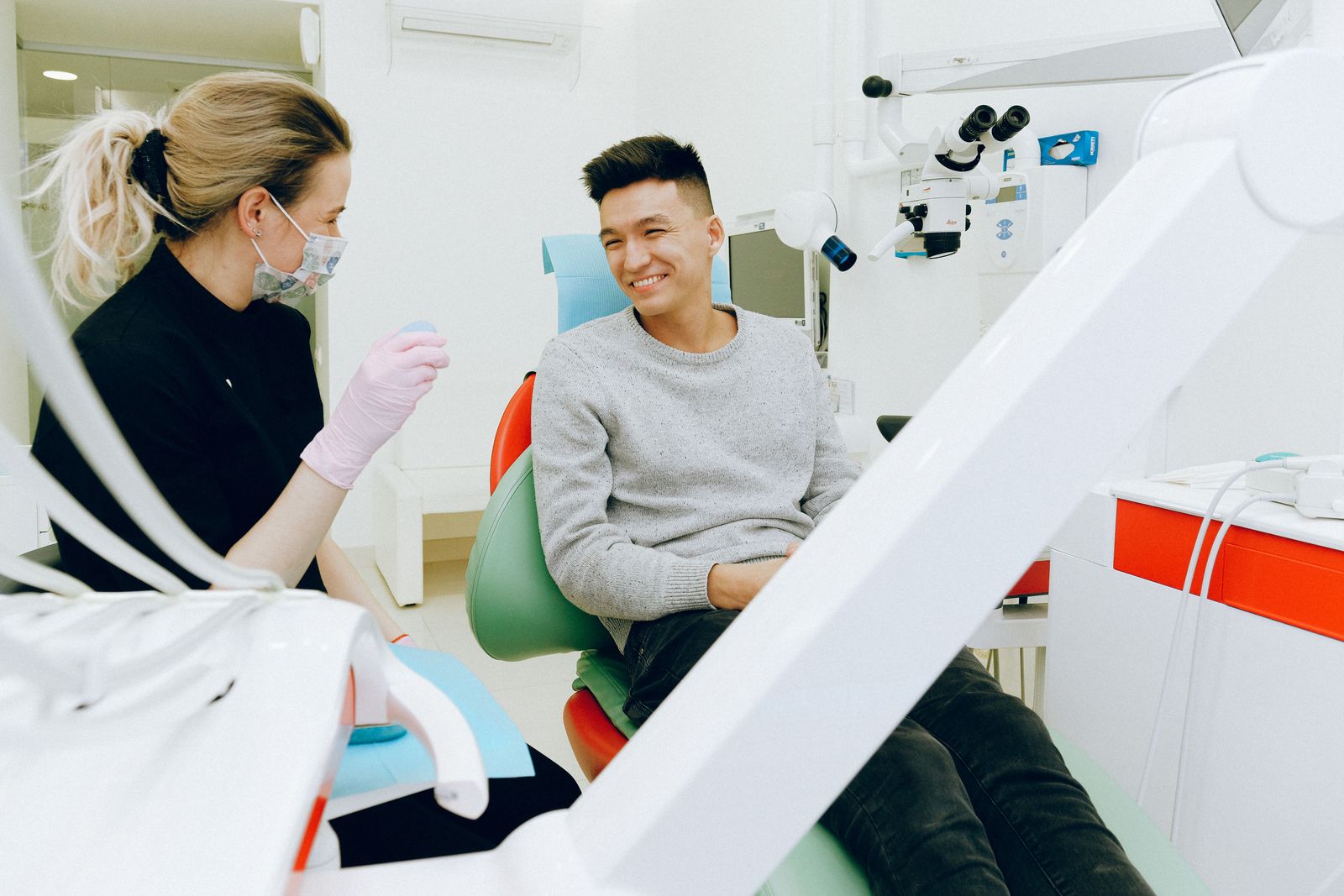
Start with a morning in an operatory, before any application.
The American Dental Association tells prospective hygienists to visit a nearby office and watch the work: scaling, radiographs, fluoride treatments and other preventive treatments, perio charting, patient education about oral health needs, and the pace of a full column. That is direct patient care, and screening for gum disease and other oral disease is part of it. If you already work as a dental assistant, you have seen the room. Dental assistants sit in the same operatory and watch dental care happen all day. You have not done the hygiene job. Assisting is useful context. The hygiene degree is still required.
Career-changers do not need a special diploma. A high school diploma or GED is the floor, and you will likely owe college-level biology, chemistry, oral anatomy, and related dental sciences before a program will look at you. That gap is normal. Many applicants spend a semester or two at community colleges knocking those dental sciences courses out, then apply to the professional phase. Course lists live on the prerequisites post. Treat that semester as step two.
There is no licensed hygiene path that skips school. If that is still an open question, read whether you have to go to school to be a dental hygienist and come back. Every state expects graduation from an accredited entry-level program.
Get into a CODA-accredited program
Everything downstream depends on this decision.
The Commission on Dental Accreditation is the body that accredits dental hygiene education in the United States. Search programs in the CODA program finder. An accredited dental hygiene program is the only route the state licensing board will accept. Graduate from a program that is not accredited and you will not be eligible for the national board or for state licensure. There is no workaround later.
Count on about three years once you are in a program. The Bureau of Labor Statistics treats an associate degree as the typical entry credential and says dental hygiene programs usually take three years to complete. The ADA puts most associate degree programs at a minimum of two years, with four-year baccalaureate options at some universities, and notes that there are more than 300 programs accredited across community colleges, technical colleges, dental schools, and universities. Use those two sources as the range. The school-length post has the associate or bachelor's degree breakdown.
A bachelor's degree is not required to start practicing. Teaching, research, some public health roles, community outreach, and later professional growth often want one. If your goal is a license and a chair, the associate path is the standard first step. Lecture can move online in some programs. Clinical training hours stay in person, inside supervised clinical practice. A fully online path to initial licensure is not a CODA path.
When you compare schools, ask for three things a brochure will not volunteer: whether the program is currently CODA-accredited, when the next cohort starts (many admit once a year), and how graduates sit the national and clinical boards. The American Dental Education Association also notes that licensure generally requires a CODA-accredited program, the written national board, a state or regional clinical exam, and often a jurisprudence exam. Some programs take applications through ADEA DHCAS. Some do not. Follow the school you are actually applying to.
Finish school, then sit the boards
School is the long middle. The boards are two different tests, in a set order.
The National Board Dental Hygiene Examination is the written national board. It is built and governed by JCNDE and delivered at Pearson VUE test centers. The exam is there so state boards can see that you can take biomedical sciences and dental hygiene science and use it on a patient problem. You apply through JCNDE. Eligibility is confirmed by your program director, or by proof that you already graduated from an accredited program. Results post in three to four weeks. Your program will tell you when they consider you ready. Most candidates sit in the final year, while the material is still close.
After the written board comes the clinical exam. It is the hands-on test your state accepts: periodontal assessment and instrumentation under examination conditions, scored as clinical practice, on a patient or a manikin, depending on the board. Which exam your state takes is a state-board question. A minimum score of 75 is required to pass the NBDHE, the national written examination, which the ADA administers through its national dental examinations arm. Many states also require a jurisprudence exam on that state's dental practice act, current Basic Life Support or CPR, and a background check. Licensure renewal typically requires continuing education every one to two years. The license post walks the packet. Written board first, then the clinical exam your state accepts, then the license application.
Do not job-hunt on the strength of a graduation photo. Dental offices hire a licensed dental hygienist. Marketplaces that employ hygienists check the same license. Dental hygienists work under the supervision rules of the state that licensed them.
Get the state license before you look for work
Every state requires dental hygienists to obtain licensure. Requirements vary, but the shape holds: accredited degree, written board, clinical exam, then an application to the state licensing board where you will work. The BLS points you at your state's Board of Dental Examiners and at CareerOneStop for the current list. Read that list while you are still in school, weeks before scores post.
The application is paperwork: transcript, exam results, fees, and whatever else that board names. Processing time is a state fact. Apply as soon as the board will take a complete file.
Until the license is active, you remain a graduate. You cannot legally practice. You cannot join Kwikly as a hygienist. If someone offers you "hygiene experience" under the table while the application sits, that is a way to start a career with a board problem.
For the checklist view of education requirements, exams, and the licensure process, use the requirements guide.
After licensure: treat the first job as a career start
The American Dental Hygienists' Association ends the path the same way: enroll, pass the license exams, then begin the job search. Many dental hygienists also go there for continuing education classes after licensure. Treat that search as a career decision.
Home offices make a good first job, and so do DSO seats. Temping sits in that same group. New graduates use temp days to build speed across software, appointment lengths, and different office cultures.
W-2 temping treats the shift like employment. The company that sent you also sits behind the day. A last-minute cancel can leave you unpaid after you already turned down another chair. Kwikly is one employer path. If an office cancels a confirmed shift less than 24 hours out, or shortens it inside that window, Last-Minute Pay Protection pays you in full. The shift card lists the rate, the hours, the skills, and the dental software, so the first morning is not a surprise.
No marketplace can skip the sequence. Apply on the hygienist page when the license is in hand. Before that, the next step is a program.
Questions people ask before they start
Do I have to go to school to become a dental hygienist?
Yes. Licensure is built on graduation from a CODA-accredited entry-level program. There is no test-only path and no on-the-job hygiene license. Aspiring dental hygienists complete approved courses in an accredited dental hygienist program first.
Do I need a bachelor's degree to start?
No. An associate degree from an accredited program is the typical entry credential. A bachelor's degree is a later choice for some teaching, research, and public health roles, and many dental hygienists add continuing education over a dental hygiene career. It is not the first step into a chair.
Can I work or temp as a hygienist before I am licensed?
No. The license is what makes the work legal. Kwikly onboards licensed hygienists. Graduation week is not the same as a license date.
How long before I can take a first job?
Plan from the program. BLS puts most dental hygiene programs at about three years. Add the prerequisite semester if you still owe science, then the weeks your state takes to issue a license after the exams. The school-length post is the deeper timeline.
What should I do this week?
Watch a hygienist work. Open the CODA program finder and write down three accredited programs you can actually reach. Copy each school's prerequisite list and next start date. That is the first step that turns a search into a plan.
Take the next step in the right order
Accredited program, boards, state license, then a first job you treat like a career. That is the whole sequence. The first steps to becoming a dental hygienist stay in that order.
If you are still short of a program, pick one that is CODA-accredited and start the science it asks for. If the license is already on the wall, the next door is employment.
Licensed hygienists can apply with Kwikly for a W-2 start: join as a hygienist.